
A bank can protect its own servers and still face a serious incident through a company it trusts. A website can run carefully reviewed application code and remain exposed through the software underneath it. An employee can recognise badly written scam emails and still be deceived by a polished message—or a familiar-sounding voice.
November's security news brings these risks together. Financial firms have disclosed incidents involving outside providers. Maintainers have released fixes for serious flaws in PHP and Java, technologies that sit beneath everyday digital services. Meanwhile, AI is helping people search for weaknesses, write persuasive messages and work through technical tasks faster.
The important question is how those developments connect. It is tempting to tell one dramatic story in which AI broke into the banks and every service interruption was part of the same campaign. The available evidence does not support that account.
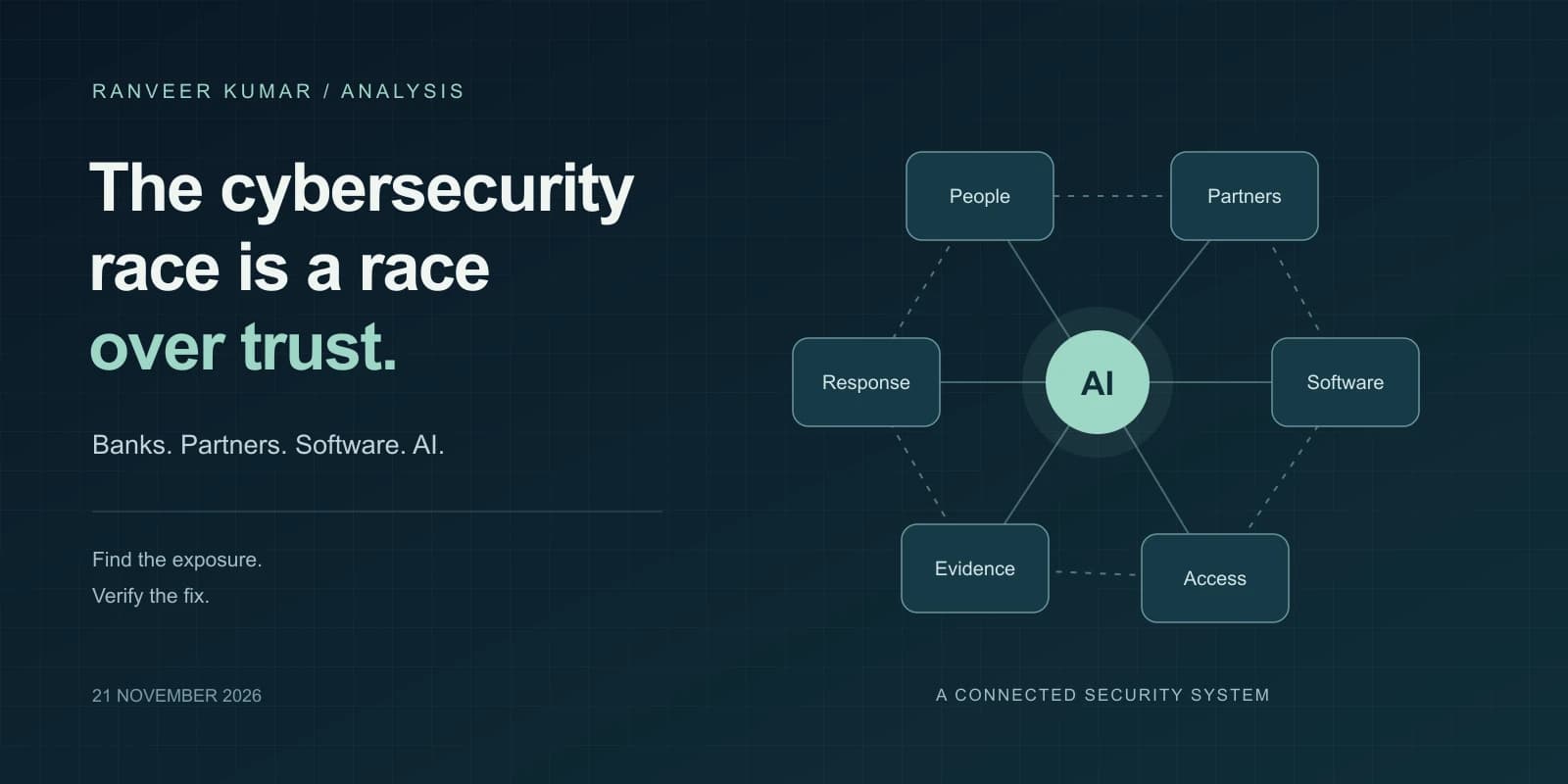
What it does support is a more useful conclusion: security depends on the relationships between systems, people, suppliers and software. AI puts those relationships under greater pressure. It can also help defenders understand and protect them.
Reporting cut-off: 21 November 2026. Incident details and product guidance can change. Company statements below describe what those organisations had disclosed; the practical recommendations and hypothetical examples are my analysis, not findings about those incidents.
What the recent financial incidents actually establish
Crédit Mutuel Arkéa: access through a service provider
In a 4 November statement, Crédit Mutuel Arkéa said attackers reached it through a service provider's platform and used the bank's own account for fraudulent transactions to other banks. It said customers' assets were unaffected, although some transfers were delayed.
The bank did not confirm the exact loss figure circulating in reports. It said some funds had been blocked and recovery work was continuing. That distinction matters: a reported amount, the value of attempted transactions and the final financial loss are different things.
The broader lesson is about delegated trust. If a partner can initiate or support sensitive operations, the security of that relationship deserves scrutiny alongside the bank's own infrastructure. A supplier questionnaire alone cannot show whether a particular account has too much authority or whether unusual transactions will be stopped.
Chase, Visa and Mastercard: vendor-held information
Associated Press reported on 19 November that Chase customer information had leaked after attacks on third-party vendors. The bank described marketing data, potentially including names and email addresses. AP also reported confirmations from Visa and Mastercard, without impact to payment information or their functions. This does not establish that core banking systems were penetrated.
A separate distinction is essential. Chase's 16 November service disruption was attributed to a software bug, according to AP's outage reporting. An outage and a breach can occur in the same week without sharing a cause.
The lesson from vendor-held data is that security responsibility follows the information. Moving customer records to a marketing or concierge platform changes where protection is needed; it does not make the consequences of exposure disappear.
Optimizely: a different route through trusted website code
In its 19 November advisory, Optimizely said an attacker exploited its Web Experimentation signup flow on 16 November to impersonate users and insert malicious JavaScript into targeted customer projects. The company said it removed the code and closed the flaw, and that the incident was limited to that product. It specifically described this as something other than a credentials breach.
This illustrates a software-and-service supply-chain risk: a legitimate tool already permitted to change a website becomes a route for unwanted code. It is a separate incident from the financial-firm disclosures above. The evidence cited here does not connect them, identify PHP or Java as their entry points, or establish that AI caused any of them.
The real perimeter includes people, partners and dependencies
Think of an organisation as a busy building with several authorised entrances. Staff badges, supplier access, maintenance doors and delivery routes all serve legitimate purposes. Protecting the front reception desk leaves the rest of that arrangement to be examined.
The digital equivalents include employee laptops, vendor support accounts, cloud integrations, automated service accounts and software build systems. Each can carry some form of trust: permission to read data, modify software, approve work or connect to another service.
These are related risks, but they are not interchangeable:
- A data-processing supplier holds information that can be exposed without an attacker entering the customer's network.
- A trusted access provider can create a path into the customer's systems or operations if its access is abused.
- A software dependency or delivery service can introduce vulnerable or malicious code into something the customer runs.
- An employee or partner device can become a place from which legitimate credentials or sessions are misused.
For an architecture review, I would follow the permission rather than the company logo. What can this connection read or change? Who owns it? Does it expire? Can we disable it quickly? What independent check stands between that access and an irreversible transaction?
This approach also avoids blaming an employee whenever a breach involves an account. A usable, secure workflow should withstand a plausible mistake and limit what one compromised identity can do.
PHP and Java: why flaws underneath applications matter
PHP commonly runs website logic on servers. Java applications run on a software platform called a runtime; OpenJDK is a major open-source implementation of that platform. A business may use either indirectly through a purchased product or a hosting service.
A flaw in application code affects that application. A flaw in a widely reused runtime can require investigation across many applications at once. It is like discovering a faulty component used in several different models of appliance: ownership and installation details suddenly matter as much as the component's name.
PHP: October's critical fixes were followed by November updates
On 21 October, the PHP project released fixes for CVE-2026-109618 and CVE-2026-109619, which it said could permit remote code execution without a login. In plain English, that means an attacker might make an affected server run instructions of the attacker's choosing. The project urged users serving web requests to update. See the PHP project's release notices.
The same archive records another round of security releases on 19 November: PHP 8.2.36, 8.3.37, 8.4.28 and 8.5.13. PHP's advance notice said the critical issues in that round required non-default configurations or uncommon setups. Those conditions should shape assessment, rather than a blanket assertion that every PHP site is exploitable.
The November changelog includes CVE-2026-129289, involving PHP-FPM request smuggling, and CVE-2026-129496, a timezone-cache memory-handling flaw with potential code execution. These are additional fixes, not different names for October's pair.
For an operator, the practical question is whether each deployed installation contains the relevant fixes. A hosting provider or operating-system vendor may backport a security fix without matching PHP's upstream version number. Ask for the vendor advisory and package evidence. Updating a website's theme or application package does not by itself prove its PHP runtime was updated.
Java4Shell: serious, with important conditions
On 17 November, Calif disclosed CVE-2026-114938, called Java4Shell, in OpenJDK's Base64 decoder. Base64 is a routine way of representing data for transport; most users never see the decoding machinery. Calif described a memory-corruption problem in its accelerated implementation and demonstrated application-specific routes to code execution. Its technical disclosure identifies affected OpenJDK builds and the relevant x86-64 processor requirements, including AVX-512 VBMI support; it says ARM64 is unaffected by this particular flaw.
Those qualifications matter. This is not evidence that every Java application can be taken over with one universal request. Hardware, runtime build, configuration and the application's reachable code paths affect exposure.
Oracle's 17 November patch advisory provides the vendor patch information. CISA's Java alert urges organisations to locate affected installations, including runtimes bundled inside other products and container images. A copy hidden inside a vendor appliance can be easy to miss in an inventory that only lists explicitly installed Java packages.
The nickname should not dictate the response. Use the advisory for the actual runtime distribution and application. Test and deploy supported fixes; treat documented workarounds as temporary measures requiring validation.
Discovery is one clock; deployment is another
Calif reports using AI assistance in its PHP2Shell research and Java4Shell work. That is evidence of AI-assisted security research. It does not establish AI involvement in the banking incidents.
My operational concern is the gap between knowing a flaw exists and proving that every affected running service has been repaired. Someone must find the software, identify an owner, obtain the right update, test it, restart or redeploy the workload and verify the result. Faster discovery increases the value of making that process reliable.
What AI gives attackers
The UK's NCSC 2026 assessment describes AI as an accelerator across reconnaissance, social engineering, vulnerability research and exploit development. It also stresses that adoption and capability are uneven and human operators remain important. This is a stronger basis for analysis than assuming autonomous attackers can reliably do everything.
Faster reconnaissance
Reconnaissance is the work of learning about a target before attempting an intrusion. AI can help organise public information, summarise technical material and connect details that would otherwise require manual reading.
Consider a hypothetical supplier-support scam. Public information reveals a company's software stack and a current migration project. That context can make an invented support request feel timely and knowledgeable. The names and technologies may be genuine even though the person contacting the employee is not.
More convincing phishing and impersonation
The FBI's guidance on generative AI and financial fraud describes criminals using generated text, images, audio and video to make deception more believable and reach more people. Translation and polished writing weaken the old assumption that spelling mistakes will expose a scam.
Imagine a finance employee receiving an urgent request to change supplier payment details, followed by a voice message resembling someone they know. This is an illustrative scenario, not a claim about the incidents above. A sensible safeguard is an independently verified callback and a separate approval step. Fluency or a familiar voice should not authorise a payment.
More automation around technical work
AI assistance can reduce repetitive work such as understanding code, drafting scripts and interpreting technical results. That can let an attacker attempt more variations or spend more time on difficult steps. It does not remove the need for access, a real weakness and a functioning chain of actions.
The defensive implication is to reduce inexpensive openings: abandoned accounts, unnecessarily public services, unchanged vulnerable deployments and broad permissions. A small weakness can become more consequential when testing it takes less effort.
How IT and security teams can use AI to find and fix risk
Defenders have a potential advantage: access to their own inventories, configuration records, authentication events and business context. The challenge is to make that information usable and sufficiently trustworthy.
The NCSC's research agenda on detection and response identifies opportunities in combining signals, enriching alerts and supporting investigations. It also warns of false confidence and low-quality recommendations. The following is a proposed operating approach, rather than a promise about any particular security product.
1. Find assets and attach an owner
Start by comparing cloud inventories, endpoint records, software lists, container registries and approved network observations. AI can assist with reconciling inconsistent names and suggesting likely relationships.
For the Java advisory, the useful output would be a reviewable list: service, runtime distribution, build, host, relevant hardware, responsible team and evidence source. Unknown entries should stay visibly unknown. A fluent answer cannot substitute for a missing inventory record.
Measure success by assets with verified ownership and patch status, not the length of the generated report.
2. Review exposed access and excessive permissions
Bring identity records and access policies into the review. Look for former staff accounts, dormant partner access, unexpectedly public storage and service accounts with broad authority.
An assistant could help group anomalies and explain why a permission deserves review. The owner must still confirm whether the access supports a current business function. Removing access automatically on the basis of a name match could interrupt legitimate operations.
3. Correlate unusual activity
A login alert, a new permission grant and an unusual download may look modest in separate dashboards. Examined together, they could justify an investigation.
Use AI to assemble a timeline and point to the underlying events. Ask it to separate observation from interpretation: “this account created a token” is a recorded event; “the account was hijacked” is a conclusion requiring evidence. Keep timestamps, source records and alternative explanations available to the analyst.
4. Prioritise vulnerabilities by exposure and consequence
A severity score is an input to a decision. It cannot, on its own, describe the importance of the business service or whether the vulnerable code is reachable.
A useful queue would consider internet exposure, evidence of exploitation, the affected version and configuration, access to sensitive data, existing safeguards and the impact of failure. AI can help connect those records and explain a proposed priority. Rules and accountable owners should control deadlines and exceptions.
For example, I would investigate a vulnerable, public identity service before a similarly scored flaw in an isolated test environment containing no production data. The reason is the possible route to harm, not a lower standard for fixing the second system.
5. Help engineers produce and validate the remedy
An assistant can draft change plans, suggest tests and help review a proposed code fix. Require it to cite the vendor guidance it used. Test security behaviour and ordinary business behaviour, then deploy with recovery available.
Afterwards, collect evidence from the running environment. Confirm the active package or runtime and check that old workloads have been replaced. Mark the issue resolved only when the relevant verification passes. A generated patch or completed ticket is an intermediate step.
6. Make response faster without losing accountability
Use AI to prepare an incident timeline, group affected systems and draft internal updates. Keep uncertain details labelled. Review customer communications before release and keep an accountable incident lead.
Begin automated actions with narrow, reversible tasks. Require stronger controls for disabling accounts, blocking transactions or changing production systems. The NCSC's agentic-AI guidance recommends proportionate autonomy, technical boundaries, monitoring and an emergency stop. Those are operating requirements worth designing before the first crisis.
The defensive AI system needs its own security boundary
An assistant reading security logs may encounter text supplied by an attacker. A request field could contain instructions aimed at the model rather than meaningful operational data. OWASP's prompt-injection guidance explains how external content can redirect model behaviour and why permissions and human approval matter.
Keep collected evidence separate from instructions. Give the assistant only the data and tools needed for its task. Protect credentials outside prompts, restrict where data can be sent and record consequential tool use. Do not paste production secrets or customer records into an unapproved public chatbot.
Evaluate the system with missed incidents, false alarms and deliberately misleading inputs. An assistant that produces reassuring summaries while overlooking the important evidence is making the team slower in a less visible way.
A practical checklist for the next security review
This is a starting agenda for teams and leaders, to adapt to their environment.
Establish the facts and exposure
- Identify business-critical services, sensitive data and the suppliers that can reach them.
- Check PHP and Java advisories against actual running installations, including bundled runtimes and containers.
- Assign an owner, an evidence-backed status and a next action to each affected or unknown asset.
- Review public services, partner connections and scripts allowed to run on customer-facing pages.
Reduce the paths to harm
- Revoke obsolete access and narrow supplier and service-account permissions.
- Use phishing-resistant authentication where supported, especially for privileged access.
- Verify payment-detail changes through an independent channel and retain separate approval.
- Apply supported security updates, test business functions and verify the deployed result.
- Restrict unnecessary movement between user devices, administrative systems and critical workloads.
Prepare to detect and recover
- Ensure identity, application and infrastructure events can be investigated together.
- Test who can suspend a supplier integration and how the business will operate while it is unavailable.
- Practise restoration and incident communications; record recovery evidence and unresolved dependencies.
- Make reporting a suspicious message or mistaken action quick and blame-free.
Introduce defensive AI with measurable limits
- Begin with a bounded use case, such as alert enrichment or asset reconciliation.
- Require source evidence, explicit uncertainty and review of consequential recommendations.
- Keep sensitive data in approved environments; restrict tools and outgoing connections.
- Track investigation quality, false alarms and time to verified remediation.
- Test the emergency stop and rollback before granting broader autonomy.
What customers and employees can do
Treat an unexpected message about a real breach as unverified until checked through the organisation's established app, website or contact number. Do not use the message's own link or callback details to establish that it is genuine. Never approve a login or disclose an authentication code just because a caller sounds authoritative.
Use supported updates and strong authentication on your own accounts. Report suspicious requests promptly through the organisation's normal channel. People should not have to diagnose a software vulnerability to protect themselves from a follow-on scam.
The leadership decision: make evidence travel faster
The recent incidents show different kinds of harm: fraudulent transactions, exposed information and malicious website code. The software advisories introduce another task: locating and repairing vulnerable components across services that may have different owners.
A useful leadership test is whether the organisation can answer five concrete questions: What do we run? Who can reach it? What changed? Which finding matters first? Can we show that the fix is live?
AI can help assemble those answers. Its value depends on reliable records, controlled access and people empowered to act on the evidence. That is where investment should lead: a shorter, verifiable path from a warning to a safer running system.
Sources and reporting notes
The incident summaries use the bank's own disclosure, Optimizely's advisory and AP reporting. The software sections use maintainer and researcher publications; the AI analysis draws on NCSC, FBI and OWASP guidance. Links are also placed beside the relevant claims.
- Crédit Mutuel Arkéa: additional incident information, 4 November 2026.
- AP: third-party attack affecting Chase customer information, 19 November 2026, and the separate banking outage.
- Optimizely: Web Experimentation incident advisory, updated 19 November 2026.
- PHP release archive and PHP 8 changelog.
- Calif: PHP2Shell research and Java4Shell disclosure.
- Oracle: November 2026 security patch advisory; CISA: Java patching alert.
- NCSC: AI threat assessment, November 2026; defensive-AI research questions; agentic-AI risk guidance.
- FBI/IC3: generative AI and financial fraud; OWASP: prompt injection.
This is an original analysis. The BBC Hindi article that prompted the subject could not be retrieved during this research and is not used as factual evidence. No interviews or quotations from it are reproduced. No evidence cited here establishes AI responsibility for the specific financial incidents described.