The fastest way to weaken a design system is to celebrate it as a library before treating it as a decision-making system.
A design system is not a Figma file. It is not a component library. It is not a Storybook instance. It is not a set of tokens, a visual language deck, or a quarterly accessibility initiative.
Those assets can be part of a design system. They are not the system.
A real design system is an operating model for how product experience decisions are made, implemented, governed, versioned, adopted, and improved. It connects design intent to engineering reality. It defines how teams contribute, how standards evolve, how exceptions are handled, and how consistency survives delivery pressure.
When leaders reduce design systems to UI kits, they underfund the work that makes the system valuable. They get components without governance, tokens without adoption, documentation without behavior change, and visual consistency without product consistency.
My bias is to evaluate a design system by the decisions it removes from product teams. If every squad still negotiates spacing, error behavior, focus states, density, token usage, and contribution rules locally, the system may have assets, but it has not yet created operational leverage.
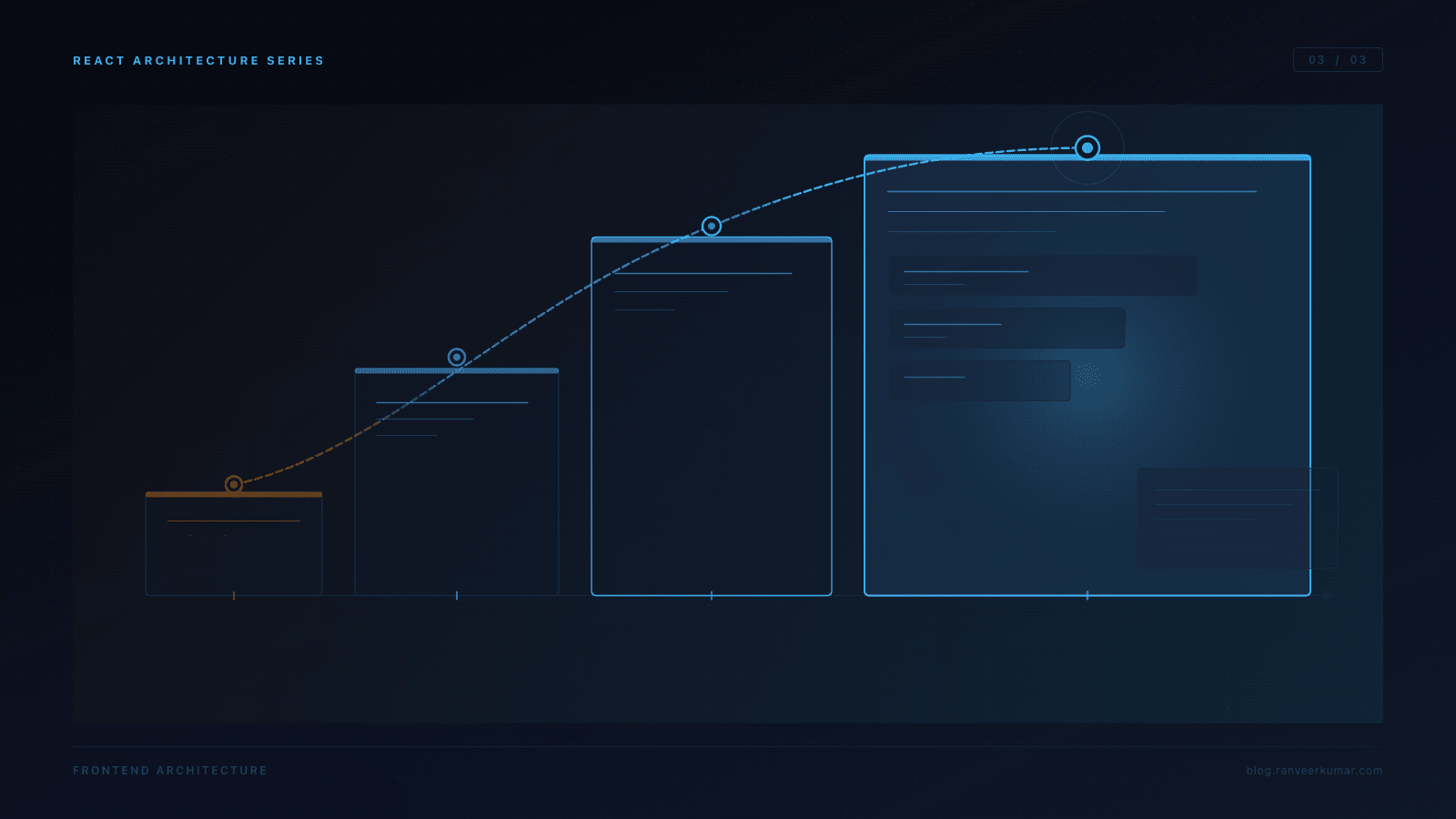
The maturity of a design system is not measured by how many components it has. It is measured by how reliably it changes product behavior across teams.
The UI Kit Trap
Most organizations begin design system work with good intent. They want consistency. They want faster delivery. They want fewer duplicated components. They want designers and engineers to speak the same language.
Then the system becomes a library. Product teams import components when convenient and work around them when they are not. Designers detach from implementation details. Engineers add props to satisfy local needs. Accessibility guidance exists but is not encoded into primitives. Tokens exist but are not wired into every product surface. Contributions happen through side conversations. Breaking changes are discovered late. Documentation is accurate for the happy path and silent on the hard cases.
This is not a tooling failure. It is an operating model failure.
That distinction matters because tooling upgrades are tempting. A better documentation site, a cleaner Storybook, or a new token package can help, but they will not solve unclear ownership. Governance is not a plugin.
Why This Becomes a Leadership Issue
At scale, a design system becomes one of the most important governance mechanisms in the frontend organization. It decides how brand, accessibility, interaction patterns, engineering constraints, and product velocity meet.
Without a mature system, every team interprets the brand locally. Every product surface negotiates spacing, color, density, error behavior, loading states, empty states, and responsive rules differently. Engineers duplicate components because the shared ones do not support real use cases. Designers create variants faster than engineering can safely implement them. Accessibility becomes a late correction instead of an embedded capability.
The cost is not only visual inconsistency. The cost is decision duplication. Every duplicated decision consumes leadership attention, review time, engineering capacity, and customer trust.
This is why frontend scaling failures often point back to design system weakness. In Why Most Frontend Teams Fail at Scale, design system governance is one of the core failure modes because the design system sits directly between product ambition and UI delivery.
What Breaks Beneath the Components
The first root cause is separation between design and engineering ownership. Design creates the language. Engineering implements the library. Product teams consume both. But if no cross-functional group owns the full lifecycle, the system fragments.
The second root cause is lack of contribution governance. Teams need to know when to request a new component, when to extend an existing one, when to create a local pattern, and how that pattern graduates into the system. Without this model, the design system becomes either too rigid or too permissive.
This is one of the most practical governance questions a UI leader can ask: what is the path from local need to shared capability? If that path is unclear, teams will either wait too long or bypass the system entirely.
The third root cause is weak token strategy. Tokens are not just color variables. They are decision infrastructure. Color, spacing, typography, radius, elevation, motion, density, and semantic states should encode product standards. If tokens are disconnected from implementation, teams will bypass them under deadline pressure.
The fourth root cause is accessibility treated as expertise instead of infrastructure. A design system should make accessible behavior the default for common patterns. That means focus management, keyboard interaction, ARIA usage, contrast, validation, error messaging, reduced motion, and semantic structure need to be designed into primitives and documented examples.
The fifth root cause is versioning immaturity. Design systems change. Components evolve. Tokens shift. Patterns deprecate. If teams do not have release notes, migration guidance, codemods where appropriate, and compatibility strategy, the system becomes risky to adopt.
The Operating Model
A mature design system needs clear ownership across five areas.
First, decision ownership. Who decides whether a pattern belongs in the system? Who approves variants? Who resolves conflicts between product specificity and system consistency?
Second, implementation ownership. Who owns the code quality, accessibility behavior, test strategy, documentation, and release process of shared components?
Third, adoption ownership. Who helps product teams migrate? Who measures adoption quality? Who identifies local patterns that should become shared capabilities?
Fourth, governance ownership. Who manages breaking changes, deprecations, exception paths, contribution rules, and design review standards?
Fifth, feedback ownership. How do product teams report friction? How does usage data shape roadmap priorities? How does the system learn from real delivery?
This operating model does not need to be heavy. It needs to be explicit.
How to Make the System Real
Start with a design system charter. It should answer:
- What problems does the system own?
- Which product surfaces are in scope?
- Who are the system's primary users?
- What are the contribution paths?
- What makes a component production-ready?
- What accessibility guarantees are built in?
- How are tokens named, versioned, and distributed?
- How are breaking changes handled?
- What metrics show system health?
Then define component readiness criteria. A shared component should not be considered ready because it renders. It should have documented use cases, accessibility behavior, keyboard behavior, responsive behavior, design states, error states where relevant, test coverage, versioning notes, and examples that reflect production usage.
In engineering terms, a design-system component is shared infrastructure. That means its API surface, accessibility behavior, migration story, and failure modes deserve more discipline than a one-off product component.
Next, create a contribution model with three paths:
| Path | Use When | Governance |
|---|---|---|
| Local pattern | The need is product-specific | Product team owns quality |
| Candidate pattern | The need appears in multiple areas | System team reviews fit |
| Core component | The pattern is broadly reusable | System owns API and lifecycle |
This prevents the system from becoming a dumping ground while still allowing it to evolve.
Accessibility as a System Capability
Accessibility is one of the clearest signs of design system maturity. If every product team has to rediscover keyboard behavior for menus, dialogs, tabs, tables, and form validation, the system is not doing its job.
Accessibility should be encoded into primitives, tested in CI, documented in examples, and represented in design specs. Designers need accessible interaction guidance. Engineers need tested behavior. Product managers need acceptance criteria. QA needs repeatable checks. Leaders need to treat accessibility as a quality standard, not a late-stage risk.
Accessibility also depends on communication quality. Tokens, component contracts, keyboard patterns, and validation behavior all need shared meaning across disciplines. That is why Communication in the JavaScript World is not only a JavaScript topic; it is also a design system topic.
Role of AI and Automation
AI can help design systems scale if the system has clear contracts. It can generate usage examples, draft migration notes, identify inconsistent component usage, create first-pass tests, summarize breaking changes, and help teams convert local patterns into reusable proposals.
Automation should handle the rules that should not rely on memory: token usage, deprecated imports, accessibility checks, visual regression, version validation, and documentation generation. AI can accelerate the work, but automation should enforce the baseline.
For leaders building AI-assisted delivery practices, AI-Assisted Engineering Is Not Optional Anymore is directly relevant. Generated UI must still follow system standards.
Leadership Takeaway
Design system leadership is product leadership. The users are internal, but the impact is external. Every decision affects product speed, brand consistency, accessibility, engineering quality, and customer experience.
This is why I do not see design systems as a side program. They are one of the main ways a UI organization turns judgment into reusable capability.
Leaders should stop asking only, "How many components do we have?" Ask better questions:
- Which product teams trust the system?
- Where are teams working around it?
- Which components create the most support cost?
- Which decisions are still duplicated?
- Are tokens applied consistently?
- Can the system evolve without painful migrations?
- Does accessibility improve because the system exists?
Closing: The System Is the Behavior
Treating a design system as a UI kit makes it easier to start and harder to scale. Treating it as an operating model makes it more serious, but also more valuable.
The organizations that get this right do not merely ship prettier components. They build a shared product language, encode quality into the platform, reduce duplicated decisions, and give teams a faster path to consistent customer experiences.
The design system is not the paint. It is the governance layer that helps the product move without losing itself. If teams can ship faster while preserving quality, accessibility, and brand coherence, the system is working. If they only import prettier components, it is still just a kit.