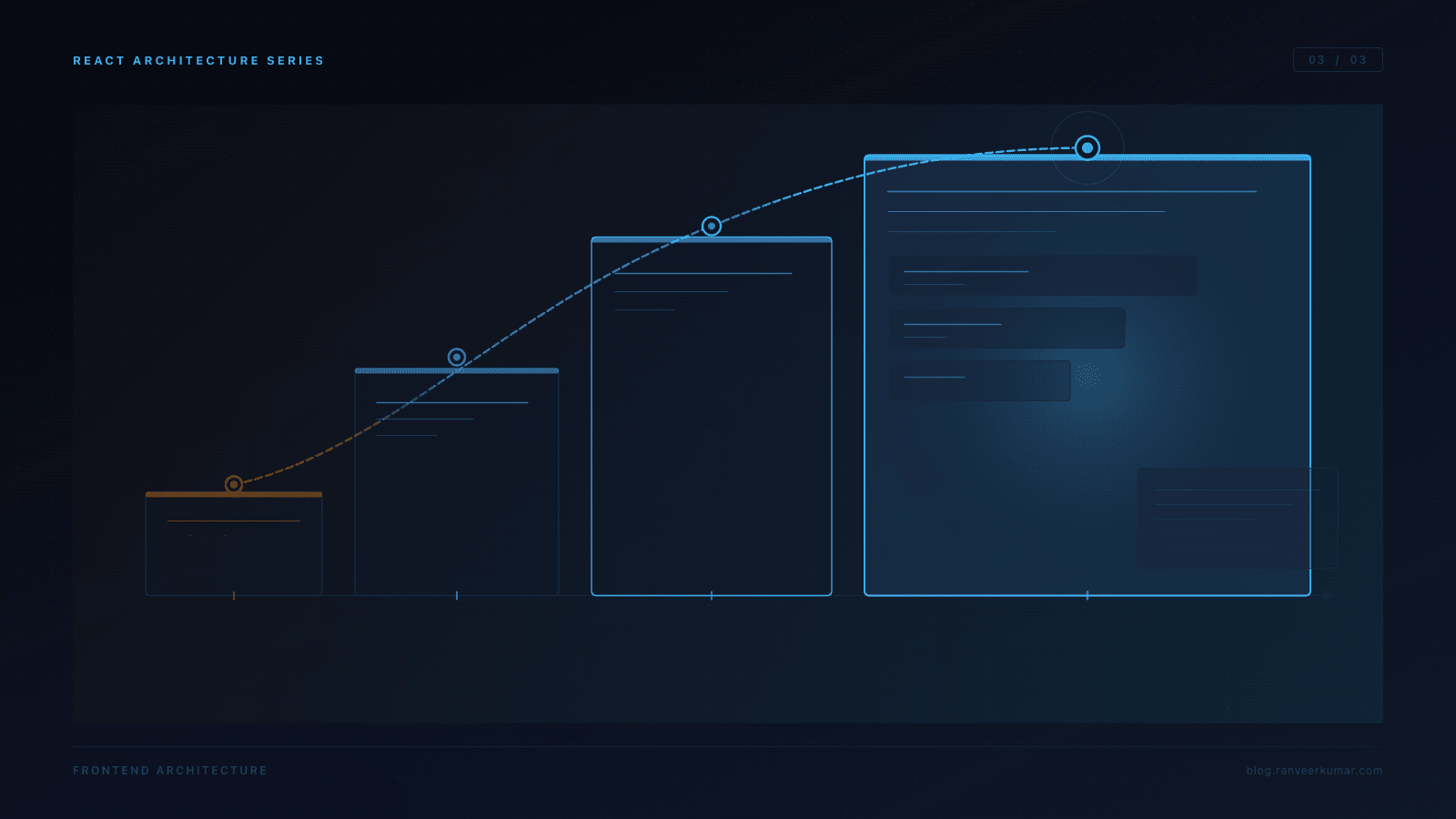
The first sign of frontend scale failure is not a broken build. It is a leadership meeting where everyone agrees the UI feels inconsistent, but every team can explain why its local decision was reasonable.
Frontend teams rarely fail because they chose React instead of Angular, Angular instead of Vue, or CSS modules instead of Tailwind. They fail because the organization keeps treating frontend as page delivery long after the frontend has become product architecture.
That distinction is not cosmetic. A page delivery mindset asks, "Can the team build this screen by Friday?" A product architecture mindset asks, "Can ten teams change connected experiences safely for the next three years?" The first question can be answered with effort. The second requires ownership, standards, operating discipline, and technical leverage.
In UI leadership, I have learned to listen for the language a team uses around the frontend. If every conversation is about screens, tickets, and handoffs, the organization is probably underestimating the architecture. If the conversation includes ownership, patterns, performance, accessibility, governance, and capability building, the frontend has a chance to scale.
At small scale, a strong engineer can compensate for weak systems. They remember the right patterns, catch visual inconsistencies, know which API is unreliable, and quietly fix accessibility misses before release. At scale, heroics become a liability. If the frontend works only because a few senior people carry the architecture in their heads, the organization does not have a frontend platform. It has institutional memory with a sprint board.
Frontend scale breaks when every team is allowed to rediscover the same product, design, and architecture decisions under delivery pressure.
Where Scale Actually Breaks
Most frontend leaders know component sprawl is painful. Fewer call out the deeper issue: component sprawl is a symptom of unclear ownership. When teams do not know who owns patterns, design tokens, accessibility behavior, state boundaries, API contracts, and release quality, they make local decisions. Local decisions are not always wrong. They are just optimized for the nearest deadline.
One product squad ships a custom table because the shared grid is too rigid. Another builds its own modal because the design system does not handle the edge case. A third introduces a second data-fetching pattern because the existing one is poorly documented. A fourth bypasses tokens because the token pipeline is slow. None of these decisions look catastrophic alone. Together, they turn the UI into a portfolio of exceptions.
The uncomfortable truth is that scale exposes leadership ambiguity faster than technical weakness. If there is no explicit model for how frontend decisions are made, the codebase will invent one. It will be expensive, inconsistent, and hard to reverse.
That is why I do not treat inconsistency as a taste problem. I treat it as evidence. The UI is telling leadership where the organization has not yet made a decision.
Why Executives Eventually Feel It
Frontend is the place where architecture becomes visible to customers. Backend duplication can be hidden behind contracts for a while. Infrastructure inconsistency can be hidden behind dashboards. Frontend inconsistency is experienced directly: slow pages, broken flows, mismatched interactions, inaccessible controls, and features that feel like they came from different companies.
This matters because scaled UI work is rarely isolated. A checkout change touches analytics, experimentation, forms, validation, accessibility, performance, localization, authentication, error handling, and customer support workflows. A dashboard change touches data freshness, caching, permissions, empty states, charts, pagination, routing, and export behavior. A design refresh touches tokens, theming, component states, documentation, and migration plans.
If the organization still funds frontend as "screen work," it will underinvest in the systems that make screen work safe. That creates a cycle: teams rush, inconsistency grows, leaders ask for standardization, platform work is treated as cleanup, deadlines return, and the same inconsistency compounds.
The Root Causes Leaders Usually Underestimate
The first root cause is inconsistent ownership. Design owns the Figma system, engineering owns the component library, product owns roadmap pressure, QA owns late-stage defects, and no one owns the experience contract end to end. This creates a gap between design intent and shipped behavior.
The second root cause is weak design system governance. A design system without contribution rules, versioning discipline, accessibility standards, and adoption strategy becomes a nice library that teams work around. The article Design Systems Are Operating Models, Not UI Kits goes deeper on this point, but the short version is simple: a design system is not mature because it has many components. It is mature when teams know how decisions flow through it.
The third root cause is fragmented state management. One team uses local state everywhere. Another uses a global store for convenience. Another treats the URL as an afterthought. Another caches server state manually. The result is unpredictable behavior: stale screens, duplicated loading states, inconsistent error handling, and hard-to-debug interactions across routes.
The fourth root cause is missing performance discipline. Performance cannot be a final audit. At scale, performance is an architecture budget. Rendering strategy, bundle boundaries, image policy, data loading, hydration, caching, analytics, and third-party scripts all need ownership. Without that ownership, every team spends a little performance until the product becomes slow.
The fifth root cause is accessibility as a review activity instead of a build constraint. Accessibility should live in primitives, patterns, testing, design specs, and acceptance criteria. If accessibility depends on someone remembering to check it at the end, it will always lose to delivery pressure.
The sixth root cause is no platform thinking. Teams share components, but they do not share paved paths. They share a repo, but not a delivery model. They share Slack channels, but not architectural contracts. For a deeper technical view, see Frontend Architecture Beyond Components. For the leadership model behind that shift, read Why UI Leadership Needs Platform Thinking.
The Operating Model That Holds
The solution is not to centralize every frontend decision. That creates a bottleneck and frustrates strong product engineers. The solution is to centralize the decisions that should not vary.
This is the balance UI leaders have to protect. Product teams need room to solve product problems. They should not need to renegotiate the meaning of loading states, token usage, keyboard behavior, error display, or server-state ownership every time a roadmap item starts.
Start with a decision map:
| Decision Area | Should Be Local | Should Be Shared |
|---|---|---|
| Product flow | Business-specific behavior | Navigation principles and error patterns |
| Components | Composition and use cases | Core primitives and accessibility behavior |
| State | Local interaction state | Server-state, URL, and cache conventions |
| APIs | Feature-specific fields | Contract shape, versioning, and failure modes |
| Performance | Page-level trade-offs | Budgets, measurement, and release gates |
This map gives teams autonomy without chaos. It also gives leaders a way to discuss frontend quality without turning every conversation into a tooling debate.
Next, create a small platform charter. It should define the application shell, routing conventions, design token pipeline, component contribution model, data-fetching patterns, accessibility standards, performance budgets, observability hooks, and release expectations. Keep it short enough that teams can use it. Strong governance is not a 70-page document. It is a set of decisions people can apply on a Tuesday afternoon without asking for a meeting.
Where AI Helps and Where It Hurts
AI-assisted engineering will make this problem more visible. If the system has strong examples, typed contracts, clear patterns, and review standards, AI can accelerate delivery. If the system is inconsistent, AI will generate inconsistency faster.
Use AI to support the operating model, not bypass it. Generate tests from approved patterns. Create migration helpers for old components. Draft documentation from code examples. Build lint rules and codemods around decisions that should not rely on memory. Use AI to speed up the mechanical parts of frontend modernization, but keep architecture judgment human and explicit.
This is also why AI-Assisted Engineering Is Not Optional Anymore is a leadership topic, not just a productivity topic. AI adoption without governance becomes another source of fragmentation.
Leadership Takeaway
Frontend scale is a leadership test. It asks whether leaders can move beyond "deliver more screens" and build the conditions for product teams to deliver consistently, safely, and quickly.
That means funding platform work before the codebase is in crisis. It means treating accessibility and performance as engineering standards, not polish. It means giving design systems real governance. It means creating architecture paths that new engineers can discover without asking the same senior engineer every time.
Closing: The Scale Test
The real scale test is not whether the best people can keep the frontend healthy. They usually can, for a while. The test is whether the system still produces coherent product experiences when delivery pressure rises, teams change, and decisions are made far away from the original architects.
When frontend is treated as page delivery, every release adds surface area. When frontend is treated as product architecture, every release can add leverage. The difference is not the framework. It is the leadership model around the framework.