in this series established that React fluency is now a prerequisite, not a differentiator. went deep on the five architecture dimensions — state, rendering, performance, scalability, and design systems — that senior frontend engineers are expected to design.
This final article is about the transition itself.
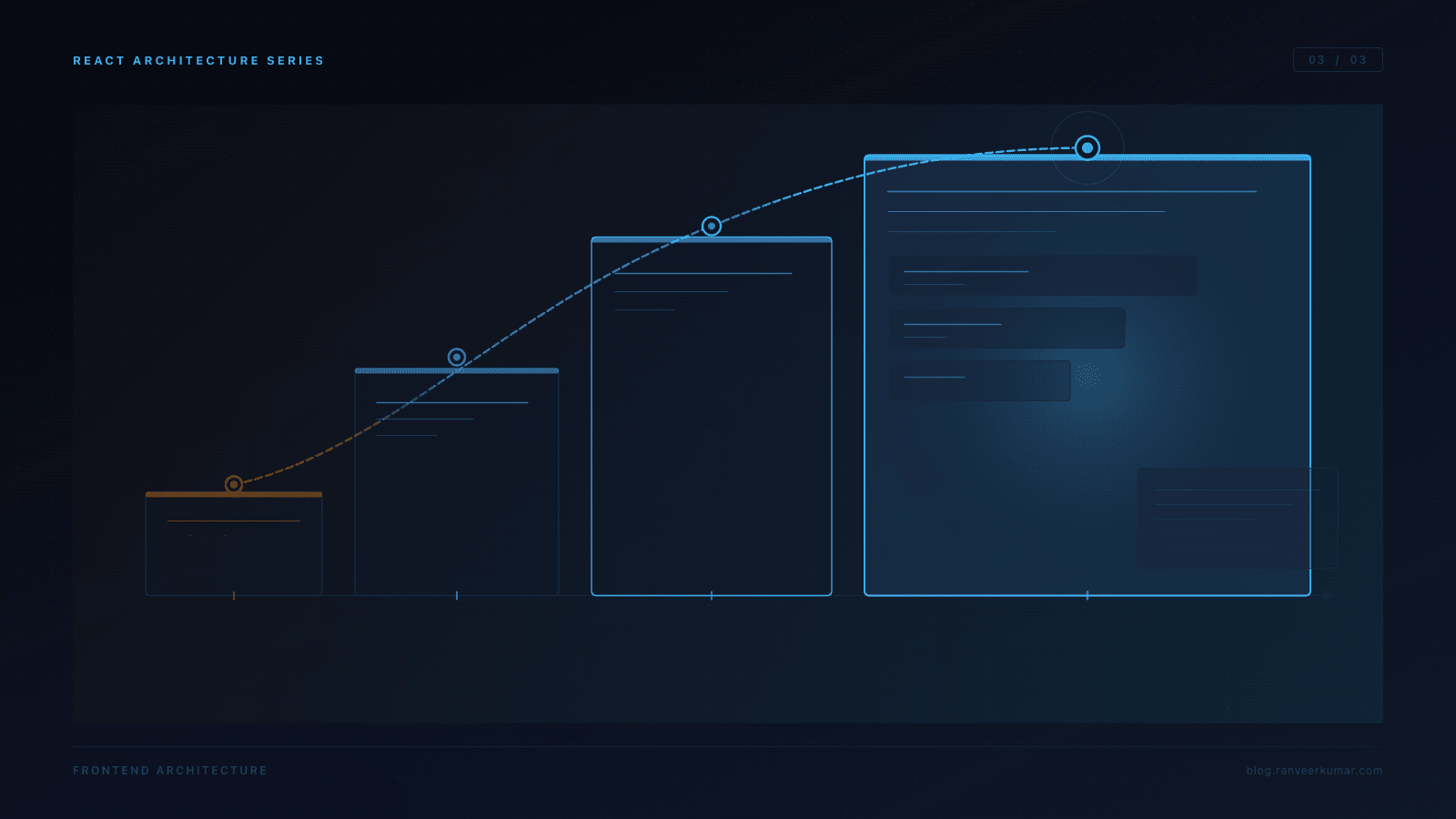
The path from React developer to frontend architect is not a single leap. It is a deliberate expansion of the questions you lead with, the artifacts you produce, and the scope of decisions you are accountable for. It requires practice in areas that most day-to-day React work does not naturally develop.
The goal is not to stop being a React developer. The goal is to become the engineer who decides how React should be used inside a larger system.
How to Think in Systems
The first skill to develop is not a new technology. It is a new instinct: the habit of asking architectural questions before writing code.
When you receive a feature request, before opening a file, pause and ask:
- Who are the users, and what constraints does their device or network impose?
- What data does this feature need, where does it come from, and how fresh must it be?
- Who owns the state this feature will create or consume?
- Which rendering model serves this feature's performance and SEO requirements?
- What happens when the API is slow, partial, or unavailable?
- Which keyboard and screen reader interactions must work?
- What telemetry will tell us this feature is working in production?
- What will make this expensive to change in twelve months?
Writing these questions down — even informally — before opening the editor changes the quality of what you build. It is the seed of architectural thinking.
The second shift is in how you communicate about work. An implementation engineer says "I built the filter component." An architecture engineer says "I designed the filter to use URL state so it survives refresh and supports deep-linking, and I bounded the performance impact by debouncing the query update." The substance is the same work. The framing demonstrates architectural ownership.
Skills to Build Beyond React
Systems-level reasoning
This means being able to describe a feature not just in terms of its component tree, but in terms of its data model, its failure modes, its rendering contract, its performance budget, and its team ownership implications.
Practice by writing system design notes before any non-trivial feature. They do not need to be formal. A bulleted list that answers the questions above is enough. The discipline of writing them builds the instinct.
Architecture Decision Records (ADRs)
An ADR captures a decision that was made, the context that made it necessary, the alternatives that were considered, and the trade-offs that were accepted. Writing ADRs is the single highest-leverage habit for developing architectural thinking.
You do not need a formal ADR template or a dedicated tool. A Markdown file in the repository with a consistent structure is enough. The act of articulating why a decision was made — not just what was decided — builds the reasoning muscle that architecture work requires.
// Minimal ADR structure — add this to your PRs for high-stakes decisions

/*
  ADR: Use TanStack Query for server state management
  Status: Accepted
  Date: 2026-06-03

  Context:
    Multiple features need to fetch, cache, and refetch API data.
    Current ad hoc approach produces duplicated fetch logic, stale data
    after mutations, and no consistent loading/error UI pattern.

  Decision:
    Adopt TanStack Query for all server state. Local UI state remains in
    useState. Global client state (auth, theme) stays in Zustand.

  Alternatives considered:
    Redux Toolkit Query — rejected due to boilerplate overhead for our scale.
    SWR — considered; TanStack Query has richer mutation lifecycle support.
    Manual fetch + Context — rejected; it recreates the problem.

  Trade-offs:
    + Automatic background refetch, cache invalidation, optimistic updates.
    + Clear separation of server state from client state.
    - Bundle weight (+12kB gzipped). Justified by eliminated custom logic.
    - Learning curve for engineers unfamiliar with the library.
*/
Performance budget ownership
Architects own the performance budget for the routes they design. This means knowing the Lighthouse or CrUX baseline, understanding which architectural decisions threaten it, and designing the feature so the budget is defended before the feature ships.
Practice by setting a performance budget for the next significant feature you build. Measure LCP, INP, and CLS before and after. Connect the metrics to the architectural choices you made. That connection is what architecture ownership looks like.
Rendering strategy reasoning
Make it a habit to explicitly justify the rendering strategy for every route you work on. Not as a comment in code — as a sentence in the PR description. "This route is SSG because the content changes weekly and SEO matters. The personalized sidebar is CSR because it depends on auth state."
That sentence is a rendering decision. Writing it makes it visible and auditable. Over time, it also exposes the patterns in your own reasoning.
Design system contribution
The fastest way to understand design system governance is to contribute to one — not just consume it. Contributing means designing a component API that works for five different use cases, not just yours. It means documenting the accessibility invariants the component owns. It means handling breaking changes with a deprecation path instead of a flag day.
If you do not have a design system to contribute to, build a small component library for a side project with explicit accessibility requirements and a token-based styling contract. The exercise of designing API stability forces the thinking that design system architecture requires.
Building Proof Through Artifacts
Architecture work is less visible than code. A pull request is easy to measure. An ADR, a state ownership diagram, a rendering strategy note, or a performance budget analysis is harder to see in a sprint report but more valuable to the team and the product over time.
The most effective way to grow as an architect is to make your architectural thinking visible. Create artifacts that others can read, challenge, and reuse.
Architecture artifacts that demonstrate seniority
Rendering strategy notes. A one-page document describing which routes use which rendering model, why, and what the performance implications are. Even a small product has interesting decisions here. Documenting them shows that you made conscious choices rather than defaulting to the framework default.
State ownership diagrams. A visual or textual map of what state exists in the application, who owns it, and how it flows. This artifact surfaces coupling, duplication, and missing normalization before they become problems.
Performance budget records. A documented baseline of Core Web Vitals for the primary routes, a target for each metric, and a log of decisions that defend or threaten the budget. This makes performance a first-class engineering concern rather than a firefighting activity.
ADRs for significant decisions. Rendering strategy, state management library choice, micro frontend boundary, real-time transport, token naming strategy, accessibility scope. Any decision that would be expensive to reverse deserves an ADR.
Component API design notes. When contributing to a design system or shared component library, document the decisions made about the API: what props exist, which are required, what the defaults are, and what use cases were deliberately excluded.
Sequence diagrams for complex flows. A data mutation flow, an optimistic update with rollback, a multi-step form with server validation — these are easier to review and extend when there is a sequence diagram attached to the implementation. Mermaid or a simple hand-drawn ASCII diagram is enough.
The 30/60/90 Day Growth Roadmap
This roadmap is designed for a React engineer who is strong at implementation and wants to build architecture fluency over three months. Adjust the timeline to your pace and current depth.
Growth Roadmap Table
| Timeline | Focus area | Practice task | Output artifact |
|---|---|---|---|
| Days 1–15 | State audit | Map all global state in your current project; classify by type | State ownership document (text or diagram) |
| Days 16–30 | Rendering strategy | For each primary route, write one sentence justifying the current rendering approach | Rendering strategy note (one per route) |
| Days 31–45 | Performance baseline | Run Lighthouse on all primary routes; identify the biggest LCP and INP bottleneck | Performance budget baseline document |
| Days 46–60 | ADR practice | Write an ADR for a real decision you are making or recently made | First architecture decision record |
| Days 61–75 | Accessible component | Contribute or refactor one shared component with full keyboard, focus, and ARIA coverage | Accessible component PR with tests |
| Days 76–90 | Full feature design | Design a moderately complex feature (data table with filtering, user dashboard, auth flow) before writing a line of code | Architecture brief: state, rendering, perf, failure, accessibility |
How to Prepare for Senior Frontend Architecture Interviews
Senior frontend interviews increasingly include a system design component. This is the round where architectural thinking is evaluated. It typically runs 45–60 minutes and asks you to design a moderately complex frontend product or feature.
The pattern that works
Open with clarification, not code.
Before designing anything, spend the first three to five minutes asking the questions that architecture depends on:
- Who are the users and what device/network profile should we design for?
- What is the primary user journey, and what is the acceptable latency for it?
- Is there an SEO requirement?
- Is the content personalized or the same for all users?
- What data freshness is acceptable?
- What happens when an API fails?
- Are there accessibility or regulatory requirements?
This behavior signals that you think in systems, not just in components. Interviewers who know what they are evaluating will reward it.
Walk through the architecture layers
After clarifying requirements, walk through the design layers explicitly:
- Data and state: what data exists, who owns it, where it lives.
- Rendering and routing: which strategy, which pages are SSR, SSG, or CSR, and why.
- Performance: what are the budget targets, which interactions are critical path.
- Error and failure: where error boundaries sit, how partial failures degrade gracefully.
- Accessibility: which interactions require focus management, keyboard support, ARIA.
- Scalability: if the team doubles, what changes?
Then — and only then — discuss component structure and implementation details.
Name trade-offs explicitly
The highest signal in a senior interview is not the answer. It is the quality of the trade-off articulation. "I would use SSR here rather than SSG because the content changes hourly and we have an SEO requirement — the trade-off is per-request server overhead, which we would manage with an edge cache and a 30-second stale-while-revalidate window."
That sentence demonstrates rendering strategy knowledge, performance awareness, and trade-off communication simultaneously. It is more valuable to an interview panel than a perfectly drawn component tree.
Sample question to practice
Design the frontend for a project management tool similar to Jira: a board view with swimlane columns, drag-and-drop card movement, real-time updates for team members, and a detail panel for individual tasks.
A strong answer covers: state taxonomy (server state for tasks via TanStack Query with optimistic updates for drag-and-drop, URL state for the selected board and active task panel), rendering strategy (CSR because it is an authenticated tool with real-time requirements), performance (virtualize the board columns if task count is large, lazy-load the detail panel), real-time (WebSocket or polling with reconnect behavior), accessibility (keyboard-navigable drag-and-drop with ARIA live regions for updates), and failure (optimistic update rollback on API failure, offline indicator, retry policy).
A candidate who covers those dimensions in 45 minutes, with clear trade-offs at each step, will stand out in any senior frontend interview panel.
Self-Assessment Checklist
Use this checklist to evaluate your current architectural readiness. Be honest — the gaps are where the growth is.
Systems thinking
- Before building a feature, I write down the constraints: users, data, performance, accessibility, failure behavior.
- I can classify state by type (local, URL, server, global) without being prompted.
- I can justify a rendering strategy choice with trade-offs, not just framework defaults.
- I design for failure before the first commit, not after QA finds it.
- I write ADRs or equivalent notes for decisions that are expensive to reverse.
Technical depth
- I can describe the difference between hydration cost and render cost, and when each matters.
- I understand cache invalidation in TanStack Query or SWR, including stale-time and refetch triggers.
- I can explain why code splitting at the wrong boundary creates waterfall requests.
- I have set a performance budget for at least one route and defended it through a feature cycle.
- I have designed a component API that separates intent from implementation (props that express semantics, not styles).
Communication and leadership
- I can draw a state flow diagram for a feature I recently built.
- I can explain a rendering strategy decision to a product manager without jargon.
- I have participated in a design review where I contributed architectural feedback, not just UI feedback.
- I have written or reviewed at least one ADR.
- I can describe the failure modes of a feature I shipped, not just the success path.
Interview readiness
- I can spend the first five minutes of a system design interview clarifying requirements without feeling pressure to draw components.
- I can describe a state taxonomy for a complex product feature without being prompted.
- I can name two trade-offs for any rendering strategy I recommend.
- I can describe where error boundaries should sit in a product and why.
- I can design an accessible interaction (focus management, keyboard support) for a non-trivial UI pattern.
If you have checked fewer than half of these, the first thirty days of the roadmap above are your most valuable next step. If you have checked most of them, the remaining gaps are your interview preparation focus.
Suggested Portfolio Artifacts
When preparing for a senior or staff frontend role, the most compelling portfolio artifacts are not deployed applications. They are design artifacts that demonstrate architectural thinking.
State architecture document. A written analysis of the state taxonomy for a product you have worked on, with classification by type, ownership, and risk. This shows classification instinct and communication clarity.
Rendering strategy decision. An ADR or design note for a rendering strategy choice — preferably one where the default approach was wrong and you caught it. This shows that you think before defaulting to useEffect.
Performance budget report. A before-and-after analysis of Core Web Vitals for a route you improved, with the architectural decisions that drove the improvement. This shows that you connect metrics to decisions, not just to profiler findings.
Accessible component contribution. A PR to a design system or shared component library where you documented the accessibility invariants the component owns. This shows that you treat accessibility as structural, not cosmetic.
Feature architecture brief. A one-to-two page design document for a moderately complex feature: state taxonomy, rendering model, performance budget, failure modes, accessibility requirements. This is the closest artifact to what senior frontend system design interviews evaluate.
The Broader Picture
Frontend architecture is not a single skill. It is a cluster of habits — asking better questions, designing before implementing, communicating decisions with trade-offs, making failure modes explicit, and producing artifacts that outlast the sprint.
These habits compound. An engineer who writes their first ADR awkwardly produces something useful. The second ADR is faster and clearer. By the tenth, the thinking is automatic: before any significant decision, the engineer instinctively frames the context, names the alternatives, and articulates the trade-offs. That instinct is what organizations pay senior and staff salaries for.
The path is not about mastering the latest framework or learning every rendering pattern. It is about developing the judgment to make the right decision given incomplete information, time pressure, and competing constraints — and to communicate that decision clearly enough for others to build on it.
Read the Series
Related Reading
For deeper technical grounding on each architecture dimension, the goes into production-level depth on each topic covered in this series: