Knowing React is valuable. But in senior frontend roles, it is no longer enough to stand out.
A few years ago, being comfortable with components, hooks, state, events, routing, and styling could position someone as a strong frontend engineer. Today, those skills are expected as a baseline. The interview starts with React. The hiring decision does not.
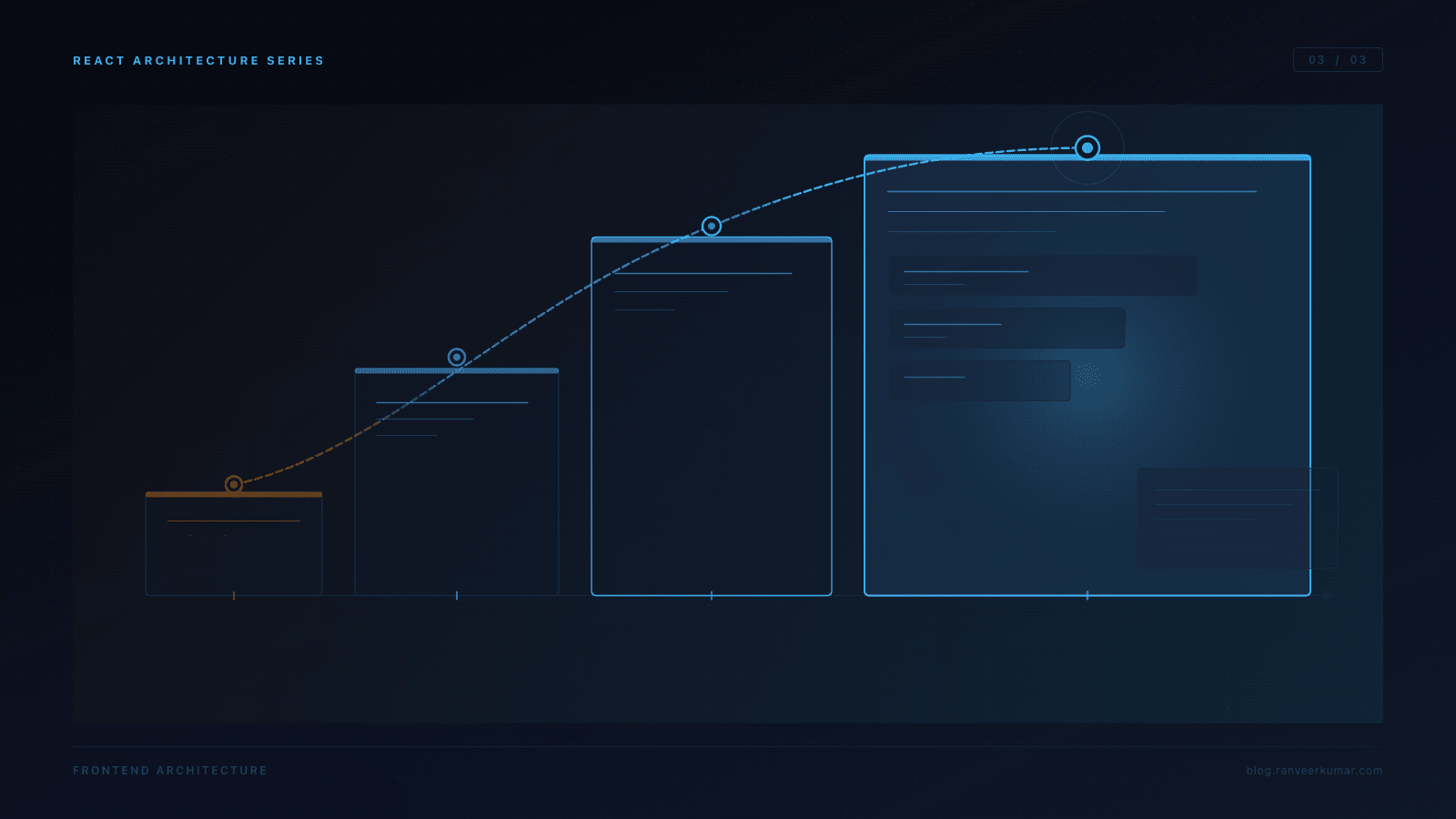
The differentiator has moved higher: from components to systems, from features to architecture, from code output to engineering judgment.
React can get you into the interview. Architecture gets you the offer.
This shift is not abstract. It shows up in how engineers are evaluated in system design rounds, in how tech leads approach feature scoping, and in the distance between an engineer who delivers on tickets and an engineer who shapes how a product is built.
This is the first article in a three-part series. breaks down the five architecture dimensions senior frontend engineers are expected to design. gives you a practical roadmap for making the transition.
Why React Became Table Stakes
React's adoption curve is one of the fastest in the history of frontend tooling. From its open-source release in 2013 to its current position as the default assumption in most hiring conversations, it took roughly a decade to become ubiquitous. That ubiquity is exactly why React knowledge is no longer a differentiator.
When a skill is listed on 80 percent of frontend job descriptions and taught in every bootcamp, university elective, and YouTube playlist, it has crossed the threshold from differentiator to prerequisite. The industry has also converged around React's core patterns. Hooks replaced class components. Context replaced prop-drilling for shallow global state. Server components are expanding what React can own in the rendering pipeline. These patterns are well-documented, widely taught, and broadly understood.
Being fluent in React hooks is no longer the ceiling. It is the floor.
This does not mean React is irrelevant. React is still the primary implementation vehicle for most senior frontend work. The question is what you are expected to do with it beyond building components. A senior engineer is expected to decide when React should be used, how data should flow through it, which rendering model the product requires, and what architectural choices will make the system easier to evolve, debug, and operate a year from now.
What the Shift Actually Looks Like
The shift from React developer to frontend architect is not about learning a new framework. It is about changing the questions you lead with.
A component-thinking engineer asks: Which component should I build? Which state hook should I use? How do I wire this API response to this piece of UI?
An architecture-thinking engineer asks: Who owns this state? How long does this data stay valid? What does this route look like at 10x traffic? What happens when this API is slow or unavailable? Which rendering strategy serves these performance and SEO requirements? How does this decision affect the team that will maintain this in eighteen months?
Both sets of questions matter. But only one of them creates leverage across an entire product surface, a team, and a codebase that outlives the sprint it was built in.
React Knowledge Gets You Evaluated. Architecture Gets You Trusted.
This distinction maps directly to how senior engineers are assessed inside organizations.
In hiring, the React fluency portion of an interview is typically a pass/fail filter. Interviewers are checking whether you can operate in the codebase. The evaluation that separates strong senior candidates from the rest is the system design conversation. Can you design a product feed with infinite scroll and real-time updates? Can you design an admin dashboard with role-based access control? Can you reason about rendering strategy, state ownership, error boundaries, caching invalidation, and performance budgets without being asked to?
In production teams, the same dynamic plays out. The engineers who get trusted with high-impact work are not always the fastest coders. They are the engineers who reduce ambiguity. They design boundaries before writing components. They catch the expensive decisions before the first pull request. They make failure modes explicit. They make performance visible as a measurable constraint rather than a vague concern.
The React Skills vs. Architecture Skills Matrix
The table below makes the distinction concrete. These are not competing expectations. They are sequential ones. React skill is the prerequisite. Architecture skill is the differentiator.
| Area | Component-level expectation | Architecture-level expectation | Senior interview signal |
|---|---|---|---|
| State | Use useState, useReducer, Context correctly | Define state ownership, normalization, cache invalidation, and sync strategy | Explains why state lives where it does, not just what it does |
| Rendering | Understand CSR and basic SSR | Choose rendering strategy per route based on performance, SEO, and data freshness | Justifies rendering choice with trade-offs, not framework defaults |
| Data fetching | Use fetch, React Query, or SWR correctly | Design server state boundaries, cache policies, optimistic updates, and error models | Describes what happens when the API is slow, partial, or wrong |
| Performance | Avoid obvious re-renders, use memo correctly | Set performance budgets, own Core Web Vitals, design code-splitting strategy | Ties performance to measurable user outcomes, not just bundle size |
| Error handling | Add try/catch, show error messages | Define error boundaries by product domain, classify errors by user impact | Distinguishes recoverable errors from blocking failures |
| Accessibility | Use semantic HTML, add ARIA where needed | Build accessibility into component API design and shared patterns | Treats a11y as structural, not a review-time annotation |
| Design systems | Use components from the library | Contribute API-compatible, token-aligned, accessible, documented components | Can explain the governance model behind the design system |
| Scalability | Write clean, maintainable components | Reason about monorepo structure, module boundaries, team ownership, independent deployments | Connects code structure to team coordination cost |
What Senior Engineers Are Actually Evaluated On
Senior frontend engineering evaluation looks like a set of layered questions. React fluency is the ground floor. The floors above it are architecture:
Layer 1 — Technical baseline. Can you write correct, idiomatic React? Can you use TypeScript effectively? Can you work in the existing codebase without hand-holding?
Layer 2 — Design judgment. Can you make a defensible decision about rendering strategy, state ownership, or component API design? Can you explain why, not just what?
Layer 3 — Failure awareness. Do you design for failure? Can you describe the error states, retry behavior, degraded experience, and observable telemetry for the features you build?
Layer 4 — System thinking. Can you reason about the feature in the context of the broader system? Can you identify the decisions that will cost the team later if made wrong now?
Layer 5 — Communication. Can you make your design legible to others? Can you write an ADR, draw a flow, describe trade-offs, and align teams on architecture decisions?
Most React developers are strong at layers 1 and 2. The differentiator begins at layer 3 and above.
The Practical Leadership Perspective
From the perspective of engineering leadership, the reason architecture matters is not ceremony. It is economics.
A team of five engineers building a feature without a shared architectural understanding will produce five locally coherent but globally fragmented implementations. One team will normalize state; another will duplicate it. One team will choose SSR for the customer-facing route; another will unknowingly break that with a client-only component. One team will design an accessible dialog pattern; another will reinvent it with hidden keyboard traps.
Senior engineers and leads prevent that fragmentation. Their architectural judgment becomes team leverage. One good decision about how state should flow through a product can save weeks of rework. One clear rendering strategy decision prevents performance debt that would otherwise arrive as a crisis in production.
The ability to make those decisions — calmly, clearly, with visible trade-offs — is what separates a React developer from a frontend architect.
// A minimal ADR template for frontend architecture decisions.
// Use it for decisions that are expensive to reverse: rendering strategy,
// state ownership, real-time transport, shared platform contracts.

type FrontendADR = {
  id: string;
  title: string;
  status: "proposed" | "accepted" | "superseded";
  context: string;
  decision: string;
  alternatives: {
    option: string;
    tradeOff: string;
    reasonRejected?: string;
  }[];
  operationalImpact: {
    performanceBudget?: string;
    accessibilityRequirement?: string;
    failureModes: string[];
    rollbackPlan: string;
  };
  reviewedBy: string[];
  reviewedAt: string;
};
The template above is not bureaucracy. It is a thinking scaffold. Writing it forces the engineer to answer the questions that distinguish senior judgment from implementation execution: why this, not that, and what breaks if we are wrong?
Why Interviews Still Start With React
There is a practical reason senior frontend interviews still open with React questions. For most product companies, the frontend runtime is React. If a candidate cannot write correct React, the architecture conversation is theoretical.
The React portion of an interview is also a proxy for how the candidate thinks about code. Does the candidate know when to lift state versus keep it local? Do they understand the hydration model? Can they reason about component composition without over-engineering it? These are still important signals.
But the React filter is exactly that — a filter. The interview opens with React to establish baseline competence. It opens for the architecture conversation to establish seniority.
A candidate who passes the React filter and then describes a state management design using only component-level thinking will not receive a senior offer from a team that knows what it needs. A candidate who treats the system design as an open question — clarifying constraints, naming trade-offs, designing for failure, expressing uncertainty where it is honest — will earn the trust of a senior interview panel.
The engineers who get trusted with high-impact work are not always the fastest coders. They are the engineers who reduce ambiguity before the first commit.
What This Means for Your Career
If you are a frontend engineer who is strong in React but has not yet developed architecture fluency, the path forward is clear:
Stop treating architecture as something that happens after the code is written. Start treating design decisions as the work itself.
Build the habit of asking — before touching code — who owns this state, which rendering model this feature needs, what happens when the API fails, and what will this cost to change in six months. Write down the answers, even informally. That discipline is what builds the architectural instinct that senior roles require.
The next article in this series covers the five architecture dimensions that senior engineers are expected to design in detail: state architecture, rendering strategy, performance budgets, frontend scalability, and design systems. Each section includes what it means, why it matters, common mistakes, and what good senior-level decisions look like in practice.
Read the Series
Related Reading
For deeper technical context, the covers these architecture dimensions in full production depth: